
Page summary
Voting for Proposition 421 on the Nov. 3 general election ballot would approve a franchise agreement between Tucson Electric Power and the City of Tucson. The agreement would extend the same, common-sense rules that govern TEP's use of public rights-of-way, supporting reliable service, prompt outage restoration, cost-effective maintenance, and coordination with city officials. The proposed 25-year agreement includes the same 2.25% franchise fee as the current agreement and would not increase customer bills.
Tucson Electric Power provides service with facilities installed along local streets, alleys, and other rights‑of‑way. In Tucson, this beneficial use of the city’s public space is managed through a “franchise agreement” with the City of Tucson.
Thanks to unanimous approval from the Tucson Mayor and City Council, city voters will have an opportunity to vote in the Nov. 3 general election on Proposition 421. The ballot measure ensures TEP can continue to readily use the City’s rights-of-way to provide the reliable electric service we have provided to Tucson for more than 130 years.
The new 25-year agreement would extend many of the terms of our current franchise, which expires this year but will remain in effect until April 2027. It is supported by a companion Energy Collaboration Agreement that promotes partnerships between TEP and the City in support of our shared energy-related objectives. Under that agreement, TEP will make a $2 million annual donation, at no cost to customers, to invest in local infrastructure and sustainability projects, such as planting more trees or shade, developing heat-resilient infrastructure or providing energy efficiency programs for low-income households.
Passing this measure won't increase electric rates. It will allow TEP to continue upgrading its infrastructure for better outage response and more reliable service.
Let's Talk 421
What is a Franchise Agreement?
Although the term “franchise” sounds like a license to operate, it is not. TEP can and must serve customers within its state-approved service territory with or without a franchise. TEP also can install, maintain, operate and upgrade its facilities on City of Tucson property without a franchise, as we do in some other local jurisdictions.
So, what does our franchise agreement do? It promotes more efficient collaboration between TEP and the City by setting terms for our use of public property, establishing clear expectations and responsibilities for joint projects, and reducing permitting delays and other holdups.
Franchise agreements are common, practical, and essential. They ensure safe, efficient access to our critical facilities, helping TEP maintain reliable power while resolving any outages without unnecessary delays.
Supporting Reliability and Safety
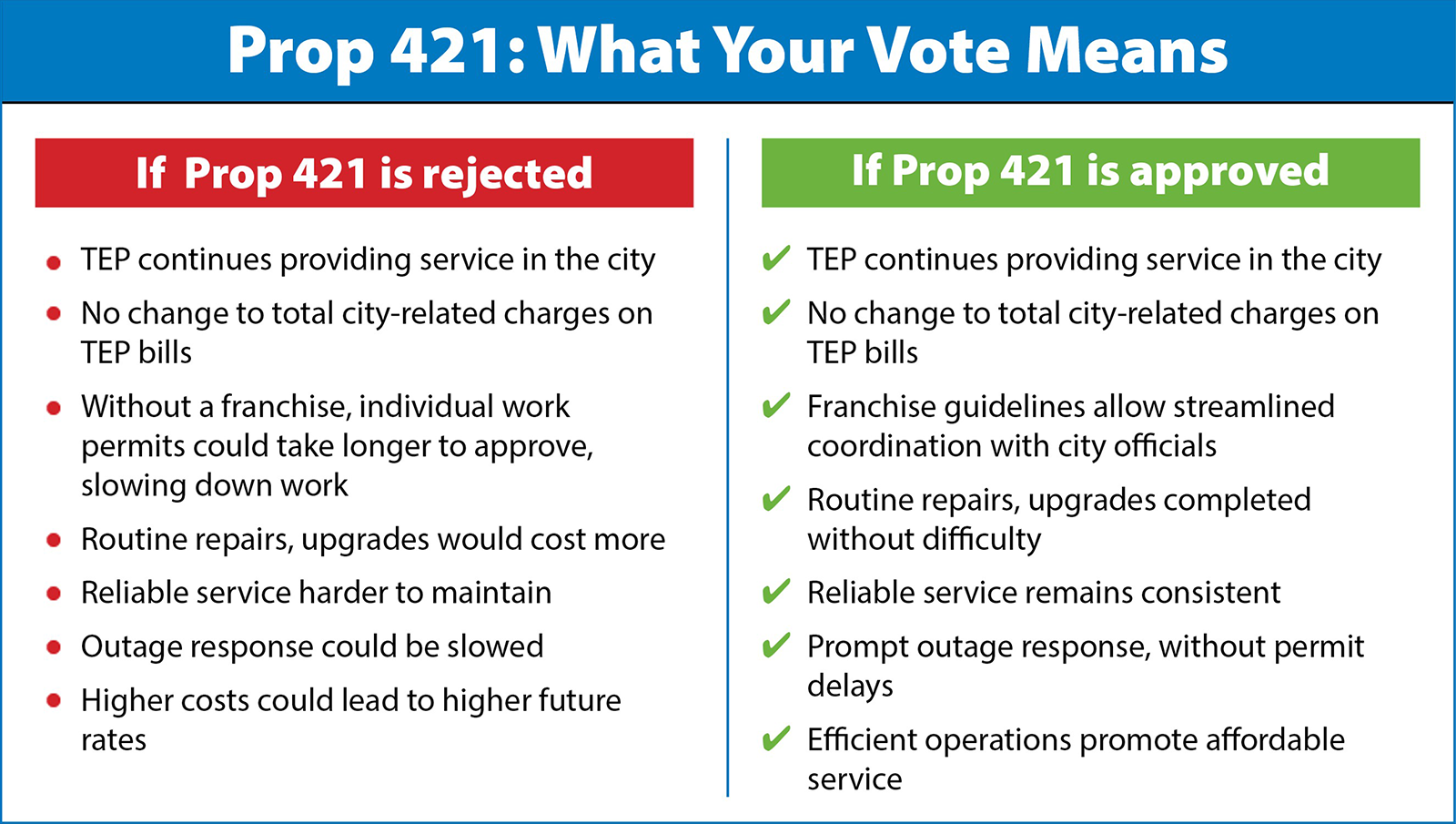
A franchise agreement allows crews to respond quickly to outages and supports routine maintenance that prevents larger problems. It also reduces delays caused by fragmented or unclear access rules.
Without a current franchise in place, restoring power and maintaining infrastructure could become more complicated, slower, and more expensive under the City’s standard permitting processes, resulting in higher costs and longer outages.
No New Fees
As consideration for TEP’s use of public rights of way, the proposed franchise would include the same usage-based Franchise Fee as the current agreement. That 2.25-percent fee is part of the TEP bills paid by customers within the City of Tucson, and those funds are remitted to the City.
The Franchise Fee does not increase customer bills because those payments are counted toward the city’s utility tax. The Tucson Mayor and City Council increased that tax to 5 percent effective March 1, 2026, but franchise fee payments reduce its effective impact on monthly bills to 2.75 percent. Without a franchise in place, customers in the City of Tucson would pay the full 5-percent utility tax.
TEP and the City of Tucson have worked well together under successive franchise agreements for many decades. Like our past agreements, Proposition 421 would help ensure:
- reliable electric service for homes and businesses,
- coordination between the City and TEP crews
- predictable rules that support economic development and public safety.
Proposed Agreement
Frequently Asked Questions
What is a franchise agreement?
A franchise agreement is authorized by State law and permits a utility to use public streets and rights‑of‑way to build, operate, and maintain infrastructure that serves the community and sets certain requirements for doing so.
Why does TEP want a franchise agreement?
TEP relies on access to public rights‑of‑way to restore outages, perform routine maintenance, and upgrade equipment. A franchise agreement helps to ensure that work can be done safely, efficiently, and without unnecessary delays. It also recognizes TEP’s ongoing, long-term commitment to work in partnership with the City of Tucson.
Would Proposition 421 change who provides my electric service?
No. TEP will continue to provide electric service in Tucson, just as it does today, regardless of whether city voters approve a new franchise agreement with the company.
Would Prop 421 affect my electric bills?
No. The new franchise includes the same 2.25 percent fee as the current agreement, and customers would continue paying the same amount to the City of Tucson through utility taxes if a new franchise is not approved by voters. Moreover, TEP’s rates are set by the Arizona Corporation Commission and are not affected by franchise agreements.
What happens if voters approve Prop 421?
TEP will continue operating under a clear, voter‑approved framework that supports reliable service, efficient maintenance, and rapid outage restoration.
What happens if voters reject Prop 421?
Without a new franchise, TEP’s access to public rights‑of‑way could be subject to new requirements and/or delays, reducing the efficiency of our operations and potentially leading to longer power outages.
How is this different from the Energy Collaboration Agreement?
They are separate agreements with different purposes. The franchise agreement addresses utility access and operations. The Energy Collaboration Agreement, or ECA, focuses on broader coordination and shared community goals and will not impact customer bills. The ECA will not take effect unless voters approve Prop 421.


Voices of Support
Chris Mazzarella, Local First Arizona
"Prop 421 will provide small business owners with the assurance of continued access to electrical services to run their operations and that when outages occur, power will be restored as quickly as possible."
Ted Maxwell, President/CEO, Southern Arizona Leadership Council
"For decades, Tucson Electric Power has provided reliable electric service that supports our region’s quality of life and economic vitality. Prop 421 establishes a practical framework that allows TEP to continue maintaining and improving this essential infrastructure efficiently while providing dependable service to a growing community."
Aracely Lucero, Senior Key Account Manager, TEP
"This measure won’t increase electric rates or change anything about our electric service. It simply extends common-sense rules that allow our work to happen more efficiently."
Jeffrey P. Nasse, Chancellor, Pima County Community College
"Proposition 421 does not increase electric rates or create a new tax. Instead, it renews the existing agreement for TEP to maintain and improve the infrastructure that delivers safe, reliable electricity to homes, businesses, schools, and essential public services, such as Pima Community College."
Francisco Estrella, IBEW Local 1116
"The men and women who maintain and restore Tucson's electric system are committed to serving their community, often under difficult conditions and at all hours. Keeping power flowing safely depends not only on their skill and dedication, but also on having clear processes that allow crews to perform maintenance, upgrades and emergency repairs without unnecessary obstacles."
Tucson Association of REALTORS®
“We support Proposition 421 because dependable electric service and well-maintained infrastructure are fundamental to every home and business. Reliable infrastructure protects property owners and supports Tucson’s housing market and economy.”
Southern Arizona Home Builders Association
“Southern Arizona continues to grow and meeting our region’s housing needs depends on reliable infrastructure. Proposition 421 helps ensure Tucson Electric Power can efficiently maintain and upgrade the electric system that serves new and existing neighborhoods across our community. Reliable, affordable energy is a critical component of housing affordability, and unnecessary delays or added costs ultimately make it harder to deliver homes that Southern Arizona’s families can afford.”
Larry Robinson, Director, Transmission and Distribution, TEP
"I support Prop 421 because Tucson needs reliable infrastructure and responsible planning. Clear agreements between the City and TEP help make both possible."
Steven G. Zylstra, Arizona Technology Council
"From emerging startups to established employers, Arizona businesses rely on dependable energy to innovate, expand and compete. Maintaining a reliable electric system helps create the stability that technology companies and other employers need to invest, create jobs and support economic growth."
Natalie Jayroe, Community Food Bank
"Local nonprofits often rely on strong partnerships to meet growing community needs. Support for programs that assist vulnerable residents, strengthen resilience during extreme weather and expand community resources can make a meaningful difference for the people nonprofits serve every day."
Grant Krueger, Union Hospitality Group
"Businesses depend on reliable electric service to serve customers, support employees and plan for future growth. Maintaining an efficient system that can respond quickly to maintenance needs and repairs helps support Tucson's economy and the quality of life that residents expect."
Fermin Samorano, Logistics Business Leader
"Communities prosper when essential infrastructure keeps pace with growth. Reliable electric service supports businesses, public services and residents alike, providing a foundation for economic development and helping ensure Tucson is prepared for future opportunities."
Jennie Grabel, Nonprofit Ecosystem Leader
"Tucson's nonprofit organizations play a vital role in helping residents navigate economic and environmental challenges. Continued investment in programs that address energy assistance, weather preparedness and community resilience can strengthen the support network that many families depend upon."
Barbi Reuter, Arizona Real Estate Broker
"Strong infrastructure is an important factor when businesses evaluate where to invest and grow. A dependable electric system helps support day-to-day operations while giving employers confidence that the region is positioned for long-term success."
Hilary Van Alsburg, Nonprofit Leader
"In Tucson, meaningful progress happens when public, private and nonprofit partners come together around shared goals. Proposition 421 reflects that approach, creating opportunities for collaboration that can help our community address important challenges while supporting a strong future for the people we serve."