Article summary
TEP donated 1,500 solar panels to Habitat for Humanity Tucson, helping provide renewable energy and lower electric costs for low-income homeowners while supporting affordable housing, workforce training and community sustainability initiatives.
Through TEP’s donation of solar panels, Habitat for Humanity Tucson is providing low-income residents with homes that feature renewable energy and lower electric costs.
Over the next three to five years, the nonprofit organization expects to install donated solar panels on about 100 new homes for low-income residents. It also plans to add solar to its construction and training warehouse and administrative office.
“We see this as delivering a promise to homeowners,” said Charlie Buchanan, Habitat Tucson’s Chief Executive Officer. “Every dollar we save goes right back into building more affordable homes because that’s our mission, plain and simple.”
The first Habitat housing development to feature TEP-donated solar panels was the 30-home Angels Crossing neighborhood, which opened in June.
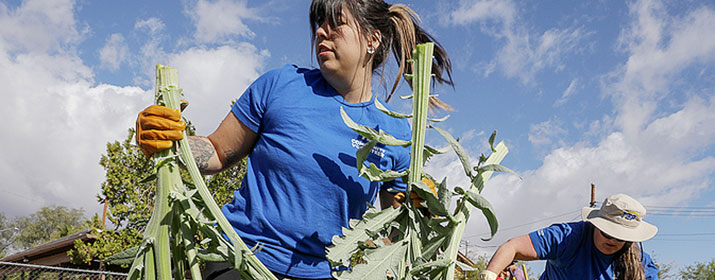
In addition to supplying the panels, TEP supported Angels Crossing in other ways. TEP volunteers gave time to help complete construction of Angels Crossing in several sessions in May and June. Caleb Adcock, TEP’s Chief Financial Officer, who sits on Habitat’s board, encouraged his employees to participate in volunteering.
TEP also donated 33 trees through TEP’s Trees for You program, which provides free and discounted trees in the community to spread shade and energy efficiency.
For TEP, the partnership reinforces our commitment to community service while helping us make progress toward a cleaner energy future for our community.
Habitat’s long-term strategic plan calls for promoting solar energy and climate resiliency at low-income housing, but officials were unsure how to afford the expenses, Buchanan said. TEP’s offer to donate 1,500 solar panels helped the organization accelerate its timeline. The partnership makes use of panels left over from a previous TEP residential solar program, said Art Fregoso, TEP Manager of Technical Services for Energy Programs.
“We thought supporting a nonprofit organization was a good use of the solar panels. It’s an easy way for a nonprofit to support others,” Fregoso said.
Habitat stored the solar panels while plans were developed to secure funds for additional equipment and installation costs.
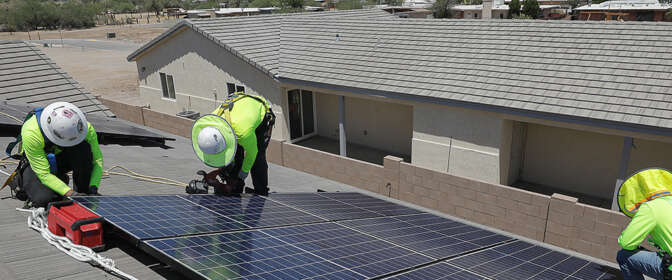
Habitat partnered with Solar Gain, a local solar system installer, to purchase equipment at a lower cost and provide technical guidance. Plus, Solar Gain employees agreed to train Habitat employees to install solar panels, enabling Habitat employees to execute work on future homes on their own.
“We hadn’t done a solar project prior to this. We want to carry it forward for future Habitat home builds,” Buchanan said.
The panel donation provides opportunities for more residents to take advantage of solar energy, said Rafael Ortiz, TEP’s Renewable Development Engineer, who helped Habitat with logistics. Because solar panels typically require high upfront costs, low-income residents often are unable to afford such installations.
In addition to the homes, which future owners help build, Habitat this summer is installing donated panels at Habitat’s Connie Hillman Family Foundation Urban Construction Knowledge Center. The center includes a construction hub, 15,000-square-foot warehouse and training center.
Habitat also secured a grant from the Nonprofit Solar Project through the Community Foundation of Southern Arizona. TEP supported the foundation’s grant cycle with a $25,000 donation. Those funds were used to install new solar panels at its administrative offices.